
Mary Annette Pember
ICT
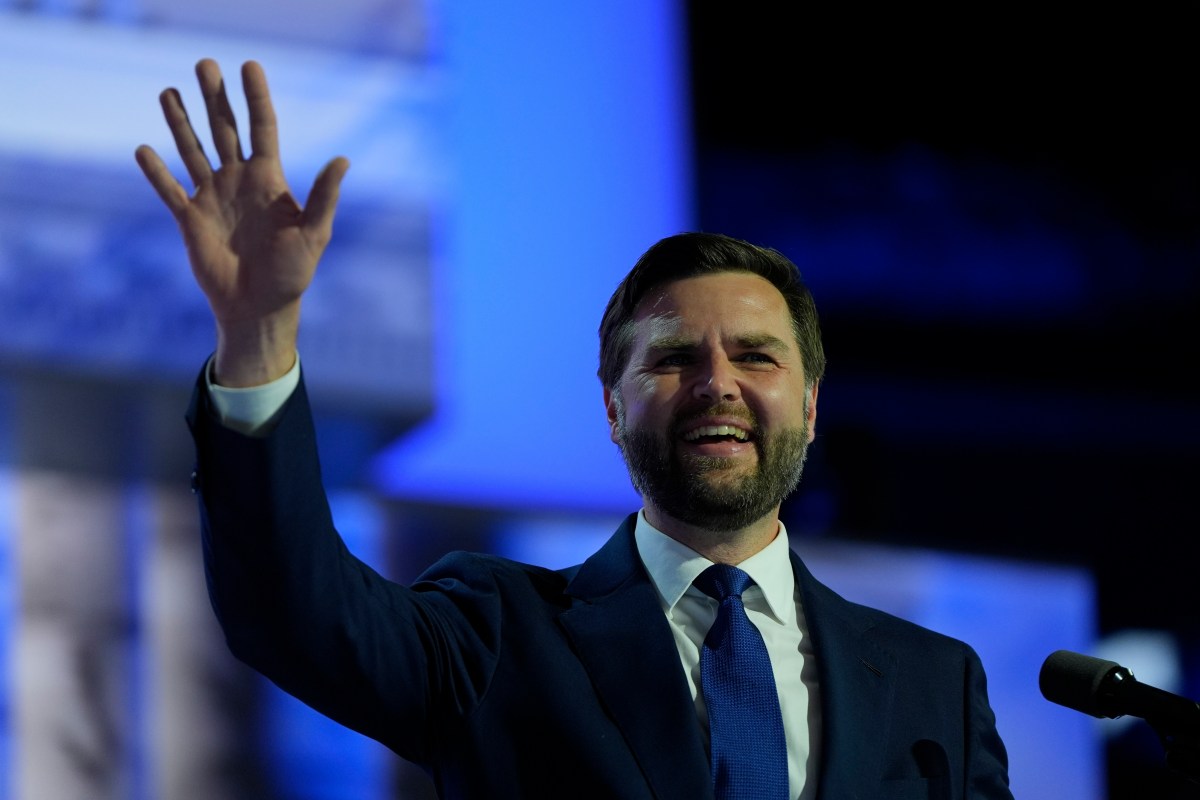
Former President Donald Trump’s decision to tap U.S. Sen. J.D. Vance as his running mate drew immediate concerns from Indigenous leaders over his views toward Indian Country.
Vance called Indigenous Peoples’ Day a “fake holiday” and praised Columbus just a few weeks after questioning the term “two-spirit” in separate postings in 2021 on social media. He also has fought name changes requested by tribal leaders for historical sites.
SUPPORT INDIGENOUS JOURNALISM. CONTRIBUTE TODAY.
The social media comments were made before Vance, a native of Middletown, Ohio, was sworn in as one of Ohio’s U.S. senators in 2023.
“‘Indigenous Peoples’ Day” is a fake holiday created to sow division,” Vance wrote on Oct. 11, 2021, on the social media site now known as X. “Of course, Joe Biden is the first president to pay it any attention.”
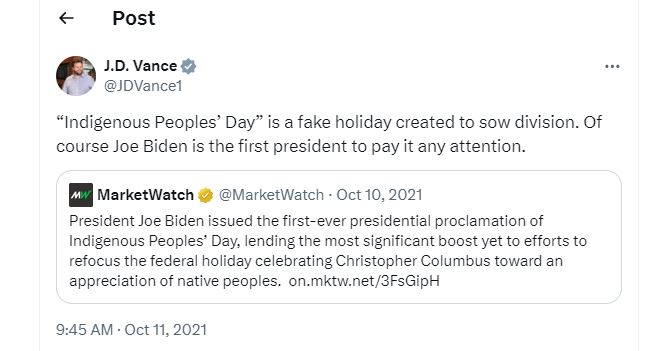
In a subsequent posting on Oct. 11, Vance wrote, “A half a millennium ago Columbus used technology developed in Europe to sail across a giant ocean and discover a new continent. Today we celebrate that daring and ingenuity. Happy Columbus Day!”
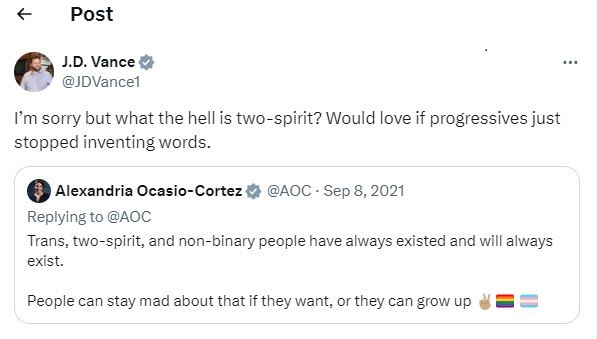
A month earlier, he commented on a Sept. 8, 2021, post from Democratic U.S. Rep. Alexandria Ocasio-Cortez of New York that makes references to “trans, two-spirit and non-binary people.”
“I’m sorry but what the hell is two-spirit?” Vance asked on the site known then as Twitter. “Would love if progressives would just stop inventing words.”
This week, after the announcement that Vance would be Trump’s vice presidential nominee, leaders at the Urban Native Collective issued a statement expressing concern over his remarks.
“These remarks undermine the inherent rights and self-determination of Indigenous Peoples and perpetuate historical inaccuracies,” according to the statement issued on Wednesday, July 17, by the collective, a nonprofit based in Cincinnati that advocates for Indigenous peoples.
‘Resilience and strength’
President Biden issued the first-ever presidential proclamation recognizing Indigenous Peoples’ Day in 2021, lending the most significant boost yet to efforts to refocus the federal holiday celebrating Christopher Columbus toward an appreciation of Native peoples.
The day is observed each year on Oct.11, along with Columbus Day, which is established by Congress.
“For generations, federal policies systematically sought to assimilate and displace Native people and eradicate Native cultures,” Biden wrote in the Indigenous Peoples’ Day proclamation. “Today, we recognize Indigenous peoples’ resilience and strength as well as the immeasurable positive impact that they have made on every aspect of American society.”
In a separate proclamation on Columbus Day, Biden praised the role of Italian-Americans in U.S. society, but also referenced the violence and harm Columbus and other explorers of the age brought with them.
Making landfall in what is now the Bahamas on Oct. 12, 1492, Columbus, an Italian explorer, was the first in a wave of European explorers who decimated Native populations in the Americas in quests for gold and other wealth, including people to enslave.
Vance has said little during his political tenure regarding Native Americans or Indian policy, as reported by Indianz.com.
Opposing tribal requests
Vance has opposed the renaming of several sites requested by tribal leaders, however.
In August 2023, as a U.S. Senator, Vance issued a public letter asking the U.S. Forest Service and U.S. Department of Agriculture to oppose changing Ohio’s Wayne National Forest to the Buckeye National Forest.
Related stories:
—Native representation at the Republican National Convention
—Miami Tribe excluded from events on own homelands
—Forest County Potawatomi chairman opens day two of the RNC
The agriculture department had proposed changing the name in response to requests from tribes and local community members, according to a press release issued by the agency. The changes is still under discussion.
“The forest is currently named after General Anthony Wayne, whose complicated legacy includes leading a violent campaign against the Indigenous peoples of Ohio that resulted in their removal from their homelands,” according to the statement.
In his letter to Agriculture Secretary Tom Vilsack and the Forest Service Chief Randy Moore, Vance wrote, “The federal effort denigrates Ohio history and represents a lack of fidelity to our nation’s founding generation.”
He went on to write, “I take exception to the U.S.D.A.’s designation of Wayne’s legacy as ‘complicated.” Labeling the life and times of Wayne in such a way is an all-too-common dismissive, academic handwave that is beneath the dignity of the U.S. government.”
In 2023, Sabrina Eaton of Cleveland.com described Wayne as a general in the Revolutionary War, nicknamed Mad Anthony Wayne either because of his bold military tactics or his hot temper.
In 2019, ICT quoted George Ironstrack, assistant director of education for the Myaammia Center at Miami University in Oxford, Ohio, about Wayne’s history with Native peoples in Ohio. The center is an initiative led by the Miami Nation of Oklahoma, whose homelands include lands in and around the Ohio river valley. They were removed from the state in 1840.
“As part of his campaign, Wayne’s forces systematically burned Miami villages, food stores and crops,” Ironstrack told ICT.
According to Ironstrack, Wayne’s strategy of starvation culminated by the 1794 Battle of Fallen Timbers, which forced the Miami tribe to the negotiating table and resulted in the 1795 Treaty of Greenville in which the Miami and other tribes ceded most of their lands in Ohio.
Vance, who is the author of the memoir “Hillbilly Elegy,” frequently touts his hardscrabble upbringing and aversion to elitism in politics as bridges to the populist wing of the Republican Party. He also opposed Trump sharply before shifting his rhetoric to support the former president.
A story published Thursday, July 18, by the news site Wired, however, details the senator’s contacts with the elite, conservative heavyweights, wealthy financiers and others that he previously had denounced.
The contacts came from a Wired analysis of Vance’s public Venmo account network. Venmo is a digital payment application that frequently makes users’ phone contacts and friends’ lists public.
Among those listed as Vance contacts is Amalia Halikias of the controversial Project 2025. Created by the Heritage Foundation, a conservative think-tank, Project 2025 sets forth a political plan that calls for dismissal of thousands of public servants, expanded power of the president, dismantling of the Department of Education, halting sales of the abortion pill and many other actions that appeal to the far right. Trump has claimed ignorance of Project 2025 but Vance has stated in previous interviews that the document has “some good ideas.”
‘We demand respect’
Vance’s nomination as the GOP’s vice presidential candidate came during the Republican National Convention, which ran July 15-18 in Milwaukee, Wisconsin.
Indianz.com noted a lack of Native events during the convention in a state that is home to 11 federally recognized tribes, but ICT reported the scheduling of a federal Indian policy roundtable organized by Oklahoma Sen. Markwayne Mullin, who is Cherokee.
A couple of Native delegates from Oklahoma were also voting at the convention, which included appearances from some tribal leaders from Wisconsin, including Forest County Potawatomi Chairman James Crawford. Former Navajo Nation Vice President Myron Lizer, who made a statement during the 2020 convention, had been expected to attend the roundtable discussion.
The announcement of Vance as the vice presidential candidate, however, came at the last minute as the convention was set to begin.
“Our rights and history as Indigenous peoples are not up for debate; we demand respect from someone in such a potentially powerful position like the vice president,” Briana Mazzolini-Blanchard, executive director of the Urban Native Collective, told ICT. Massolini-Blanchard is a citizen of the CHamoru Nation of the island of Guam.
“It’s saddening that political leaders continue to stand by these colonized names that hold such deep pain for Indigenous peoples.”
The Associated Press contributed to this article.

Our stories are worth telling. Our stories are worth sharing. Our stories are worth your support. Contribute today to help ICT carry out its critical mission. Sign up for ICT’s free newsletter.

